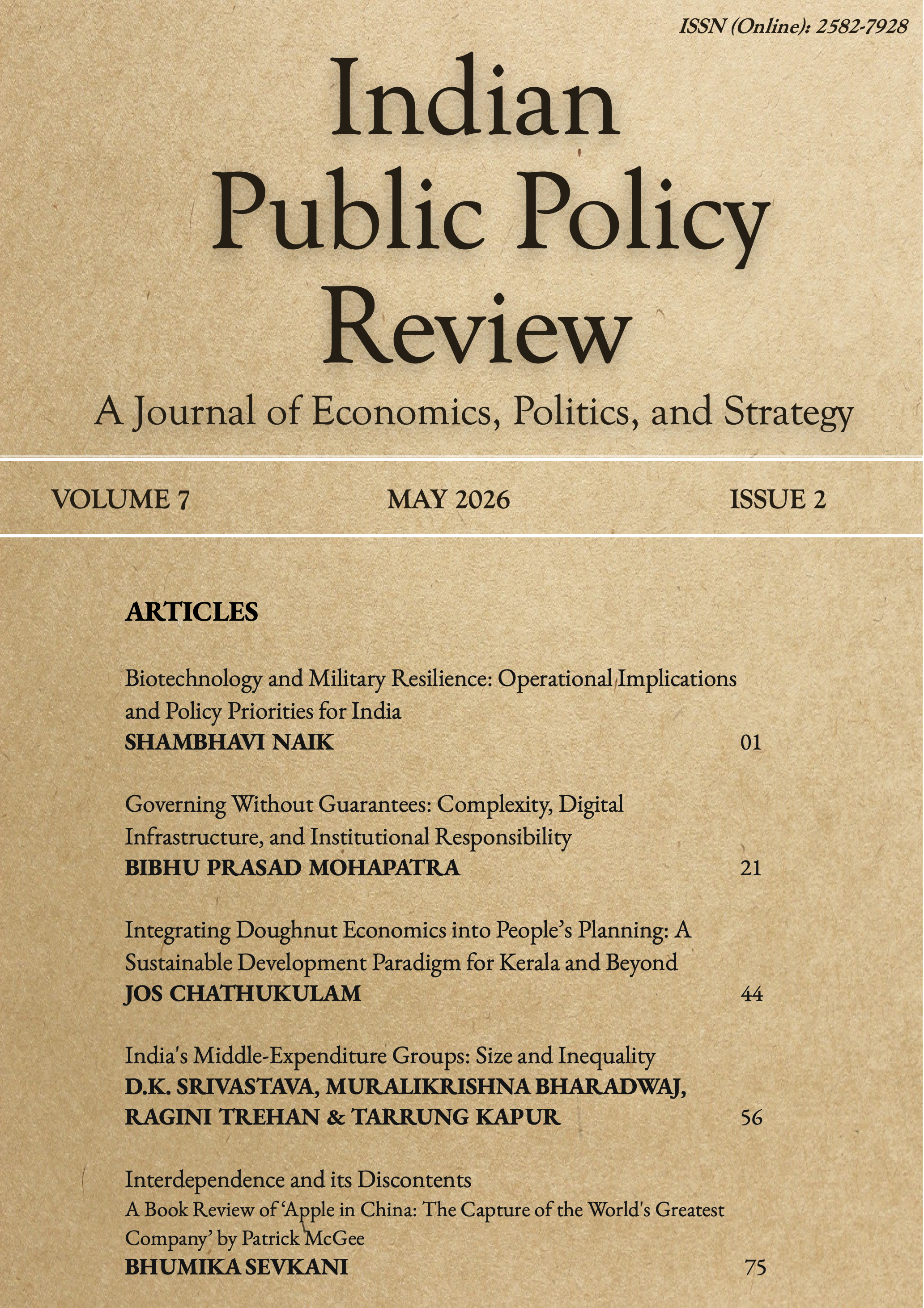
Governing Without Guarantees
Complexity, Digital Infrastructure, and Institutional Responsibility
DOI:
https://doi.org/10.55763/ippr.2026.07.02.002Abstract
Contemporary policy theory recognises that governance operates under uncertainty, yet still organises institutional action as if outcomes can be stabilised through design, incentives, and constraint. Complexity theory and interpretive critiques have unsettled the promise of control, but have paid less attention to a related shift: the erosion of responsibility within systems that cannot be fully predicted yet remain normatively accountable. This article develops the concept of Governance Without Guarantees (GWG) to describe environments in which institutional action unfolds without stable causal expectations while continuing to generate consequences that demand accountability over time. The central challenge in such settings is not uncertainty itself, but whether institutions can remain answerable as action becomes mediated through rules, metrics, and digital infrastructures. The article introduces Responsibility Retention Capacity (RRC) as a diagnostic framework for assessing whether governance arrangements keep responsibility traceable, contestable, and revisable. Drawing on digital public infrastructure cases, like identity systems and automated welfare platforms in India and the United States, it shows how embedded technical systems redistribute accountability and obscure harm. The article contributes to policy theory by reframing governance under uncertainty through GWG, offering RRC as an analytical lens, and demonstrating how digital infrastructures intensify the displacement of responsibility.
Keywords:
Institutional Responsibility, Public Choice Theory, Complexity Theory, Interpretive Policy Analysis, Institutional Ethics, State Capacity, Citizenship and Digital IdentityDownloads
References
Ansell, Chris, and Roland Geyer. 2017. “Pragmatic Complexity: A Theory of Change for Public Policy.” Policy Studies Journal 45 (1): 1–21.
Arendt, Hannah. 2003. Responsibility and Judgment. Edited by Jerome Kohn. New York: Schocken Books.
Bacchi, Carol. 2009. Analysing Policy: What’s the Problem Represented to Be? Frenchs Forest, NSW: Pearson.
Bardach, Eugene, and Eric M. Patashnik. 2019. A Practical Guide for Policy Analysis: The Eightfold Path to More Effective Problem Solving. 6th ed. Thousand Oaks, CA: CQ Press.
Baumgartner, Frank R., and Bryan D. Jones. 1993. Agendas and Instability in American Politics. Chicago: University of Chicago Press.
Behn, Robert D. 2001. “Rethinking Democratic Accountability.” Brookings Review 19 (4): 9–13.
Benjamin, Ruha. 2019. “Assessing Risk, Automating Racism.” Science 366 (6464): 421–422.
Bevir, Mark, and R. A. W. Rhodes. 2006. Governance Stories. London: Routledge.
Bhatia, Aashish, and Jacqueline Bhabha. 2017. “India’s Aadhaar Scheme and the Promise of Digital Identity.” Journal of International Development 29 (7): 949–969.
Bovens, Mark, and Stavros Zouridis. 2002. “From Street-Level to System-Level Bureaucracies.” Public Administration Review 62 (2): 174–184.
Bovens, Mark, Thomas Schillemans, and Robert E. Goodin. 2014. “Public Accountability.” In The Oxford Handbook of Public Accountability, edited by Mark Bovens, Robert E. Goodin, and Thomas Schillemans, 1–22. Oxford: Oxford University Press.
Bovens, Mark. 2007. “Analysing and Assessing Accountability.” European Law Journal 13 (4): 447–468.
Brennan, Geoffrey, and James M. Buchanan. 1985. The Reason of Rules: Constitutional Political Economy. Cambridge: Cambridge University Press.
Brodkin, Evelyn Z. 2011. “Policy Work.” Policy Studies Journal 39 (2): 253–276.
Buchanan, James M., and Gordon Tullock. 1962. The Calculus of Consent. Ann Arbor: University of Michigan Press.
Byrne, David. 1998. Complexity Theory and the Social Sciences. London: Routledge.
Cilliers, Paul. 1998. Complexity and Postmodernism. London: Routledge.
Cilliers, Paul. 2005. “Complexity, Deconstruction and Relativism.” Theory, Culture & Society 22 (5): 255–267.
DiMaggio, Paul J., and Walter W. Powell. 1991. “The Iron Cage Revisited.” American Sociological Review 48 (2): 147–160.
Downs, Anthony. 1957. An Economic Theory of Democracy. New York: Harper.
Drèze, Jean, Reetika Khera, and Meghana Mungikar. 2017. “Aadhaar and Food Security in Jharkhand.” Economic and Political Weekly 52 (50): 34–41.
Duit, Andreas, and Victor Galaz. 2008. “Governance and Complexity.” Public Administration 86 (2): 311–329.
Duit, Andreas, et al. 2010. “Governance, Complexity, and Resilience.” Global Environmental Change 20 (3): 363–368.
Eubanks, Virginia. 2018. Automating Inequality. New York: St. Martin’s Press.
Fischer, Frank. 2003. Reframing Public Policy. Oxford: Oxford University Press.
Flyvbjerg, Bent. 1998. Rationality and Power. Chicago: University of Chicago Press.
Geyer, Roland, and Sam Rihani. 2010. Complexity and Public Policy. London: Routledge.
Hayek, Friedrich A. 1945. “The Use of Knowledge in Society.” American Economic Review 35 (4): 519–530.
Helbing, Dirk. 2015. “Thinking Ahead.” Nature 526 (7571): 405–406.
Hill, Michael, and Peter Hupe. 2009. Implementing Public Policy. London: Sage.
Hintz, Arne, Lina Dencik, and Karin Wahl-Jorgensen. 2019. “Digital Citizenship.” Journalism Studies 20 (6): 731–748.
Hood, Christopher. 1991. “A Public Management for All Seasons?” Public Administration 69 (1): 3–19.
Hood, Christopher. 2011. The Blame Game. Princeton, NJ: Princeton University Press.
Isin, Engin F., and Evelyn Ruppert. 2015. Being Digital Citizens. London: Rowman & Littlefield.
Janssen, Marijn, and Jeroen van den Hoven. 2015. “Big and Open Linked Data.” Government Information Quarterly 32 (1): 1–5.
Jones, Bryan D. 2003. “Bounded Rationality and Political Science.” Journal of Politics 65 (4): 1049–1070.
Kahneman, Daniel. 2011. Thinking, Fast and Slow. New York: Farrar, Straus and Giroux.
Khera, Reetika. 2019. “Dissent on Aadhaar.” Economic and Political Weekly 54 (2): 10–13.
Laffont, Jean-Jacques, and Jean Tirole. 1991. “The Politics of Government Decision-Making.” Quarterly Journal of Economics 106 (4): 1089–1127.
Latour, Bruno. 1992. “Where Are the Missing Masses?” Social Studies of Science 22 (2): 225–258.
Lindblom, Charles E. 1959. “The Science of ‘Muddling Through.’” Public Administration Review 19 (2): 79–88.
Lipsky, Michael. 1980. Street-Level Bureaucracy. New York: Russell Sage Foundation.
March, James G., and Johan P. Olsen. 1989. Rediscovering Institutions. New York: Free Press.
Margetts, Helen, and Patrick Dunleavy. 2013. “The Second Wave of Digital-Era Governance.” Philosophical Transactions of the Royal Society A 371 (1987): 20120382.
Masiero, Silvia, and Asif Das. 2019. “Datafying Anti-Poverty Programmes.” World Development 124: 104604.
Masiero, Silvia. 2019. “Digital ID and Social Protection.” Information Technology for Development 25 (2): 289–312.
Mettler, Suzanne, and Mallory SoRelle. 2014. “Policy Feedback Theory.” Annual Review of Political Science 17: 123–144.
Morçöl, Göktuğ. 2012. A Complexity Theory for Public Policy. New York: Routledge.
Moynihan, Donald P. 2008. The Dynamics of Performance Management. Washington, DC: Georgetown University Press.
Moynihan, Donald P., Pamela Herd, and Hope Harvey. 2015. “Administrative Burden: Learning, Psychological, and Compliance Costs in Citizen-State Interactions.” Journal of Public Administration Research and Theory 25 (1): 43–69.
Mueller, Dennis C. 2003. Public Choice III. Cambridge: Cambridge University Press.
Niskanen, William A. 1971. Bureaucracy and Representative Government. Chicago: Aldine.
Obermeyer, Ziad, et al. 2019. “Dissecting Racial Bias in an Algorithm.” Science 366 (6464): 447–453.
OECD. 2024. Digital Public Infrastructure for Digital Governments. Paris: OECD Publishing.
Olson, Mancur. 1965. The Logic of Collective Action. Cambridge, MA: Harvard University Press.
Ostrom, Elinor. 2005. Understanding Institutional Diversity. Princeton, NJ: Princeton University Press.
Patton, Michael Quinn. 2011. Developmental Evaluation. New York: Guilford Press.
Pawson, Ray. 2013. The Science of Evaluation. London: Sage.
Pierson, Paul. 1993. “When Effect Becomes Cause.” World Politics 45 (4): 595–628.
Pierson, Paul. 2000. “Increasing Returns, Path Dependence, and the Study of Politics.” American Political Science Review 94 (2): 251–267.
Pierson, Paul. 2004. Politics in Time. Princeton, NJ: Princeton University Press.
Pollitt, Christopher, and Geert Bouckaert. 2017. Public Management Reform. 4th ed. Oxford: Oxford University Press.
Power, Michael. 1997. The Audit Society. Oxford: Oxford University Press.
Rhodes, R. A. W., et al. 2011. “Public Management and Complexity.” Public Administration 89 (1): 30–47.
Room, Graham. 2011. Complexity, Institutions and Public Policy. Cheltenham: Edward Elgar.
Rothstein, Bo. 2011. The Quality of Government. Chicago: University of Chicago Press.
Sanderson, Ian. 2009. “Intelligent Policy Making.” Public Policy and Administration 24 (4): 355–373.
Sandhu, Harinder, et al. 2023. “Configurational Analysis of Infrastructuring in Digital Identity Platforms.” Journal of Information Technology 38 (2): 145–161.
Scott, James C. 1998. Seeing Like a State: How Certain Schemes to Improve the Human Condition Have Failed. New Haven: Yale University Press.
Simon, Herbert A. 1957. “A Behavioral Model of Rational Choice.” Quarterly Journal of Economics 69 (1): 99–118.
Soss, Joe, Richard C. Fording, and Sanford F. Schram. 2011. Disciplining the Poor. Oxford: Oxford University Press.
Stirling, Andy. 2010. “Keep It Complex.” Nature 468 (7327): 1029–1031.
Stone, Deborah A. 2012. Policy Paradox. 3rd ed. New York: W. W. Norton.
Tronto, Joan C. 1993. Moral Boundaries. New York: Routledge.
Waldrop, M. Mitchell. 1992. Complexity. New York: Simon & Schuster.
Weimer, David L., and Aidan R. Vining. 2017. Policy Analysis. 6th ed. New York: Routledge.
Weingast, Barry R. 1995. “The Economic Role of Political Institutions.” Journal of Law, Economics, and Organization 11 (1): 1–31.
Yeung, Karen. 2018. “Algorithmic Regulation.” Regulation & Governance 12 (4): 505–523.
Zouridis, Stavros, Mark Bovens, and Margo Trappenburg. 2020. “Algorithmic Bureaucracy.” Public Administration Review 80 (3): 417–427.