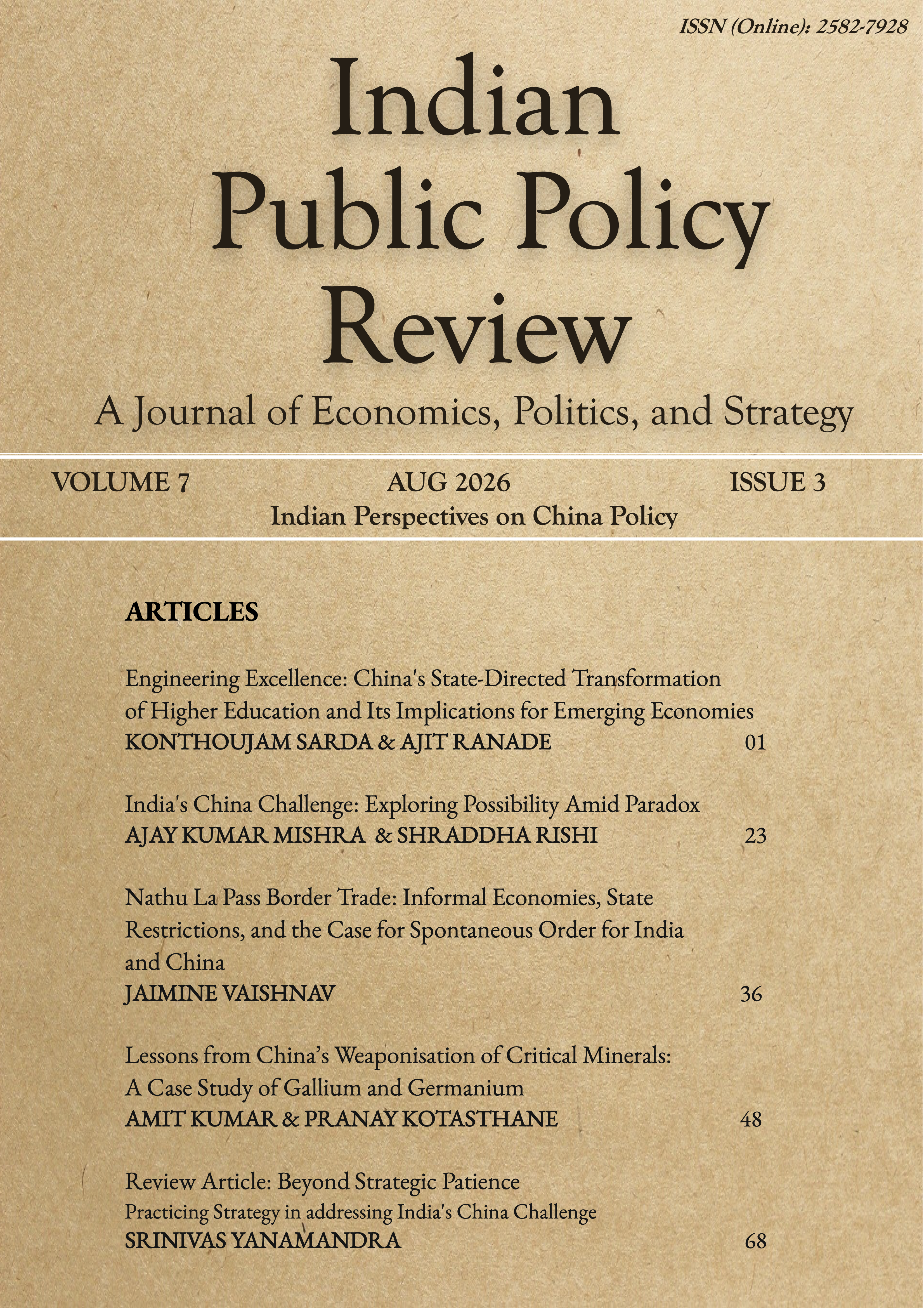
Nathu La Pass Border Trade
Informal Economies, State Restrictions, and the Case for Spontaneous Order for India and China
DOI:
https://doi.org/10.55763/ippr.2026.07.03.003Abstract
The reopening of Nathu La Pass in 2006 marked a symbolic milestone in India-China relations, yet nearly two decades later, formal border trade through this historic route remains negligible relative to its projected potential. This paper examines the political economy of Nathu La border trade, using libertarian political economy as a primary analytical lens while situating that lens within the broader context of India-China security dynamics, diplomatic constraints, and state capacity. The central argument is that excessive regulatory restrictions, including outdated commodity lists, seasonal closures, and bureaucratic licensing requirements, have depressed formal trade volumes and encouraged informal exchange in their place. Drawing on the 2020-2024 closure and the 2025 resumption of trade, the paper documents how state-imposed barriers have constrained voluntary exchange and generated informal trading networks that reflect genuine demand patterns. The acknowledges the limits of available data on informal trade and interprets indirect evidence with care. The findings suggest that meaningful trade expansion requires regulatory reform, but reforms must be calibrated to security realities rather than treated as purely technical exercises.
Keywords:
Nathu La Pass, India-China border trade, informal economy, libertarian political economy, spontaneous order, border securityDownloads
References
Chettri, Pramesh. 2018. "India-China Border Trade Through Nathu La Pass: Prospects and Impediments." HIMALAYA 38, no. 1: 11-22.
Gallien, Max. 2020. "Informal Institutions and the Regulation of Smuggling in North Africa." Perspectives on Politics 18, no. 2: 492-508.
Hayek, Friedrich A. 1945. "The Use of Knowledge in Society." American Economic Review 35, no. 4: 519-30.
Hoppe, Hans-Hermann. 1998. "The Case for Free Trade and Restricted Immigration." Journal of Libertarian Studies 13, no. 2: 221-33.
India, Ministry of External Affairs. 2003. Memorandum Between the Government of the Republic of India and the Government of the People's Republic of China on Expanding Border Trade. New Delhi: Government of India.
India, Ministry of Commerce and Industry. 2012. Revised Commodity Lists for Border Trade at Nathu La. New Delhi: Government of India.
Lachenpa, Sangay. 2025. "Beyond Confidence Building Measures (CBMs): Nathula Cross-Border Trade from the Perspective of the Border Traders." Issue Brief No. 20. Centre of Excellence for Himalayan Studies, Shiv Nadar University, Delhi NCR.
Lama, Mahendra P. 2005. "Nathu La Trade Study Group Report: Projections and Framework for Border Trade." Gangtok: Government of Sikkim.
Mehra, Malini. 2007. "Reviving the Silk Route: India-China Border Trade Through Nathu La." South Asian Survey 14, no. 1: 65-82.
Observer Research Foundation. 2025. "Sikkim's Slow Ascent: Trade, Terrain, and the Challenge of Connectivity." ORF Online, August 8, 2025. https://www.orfonline.org/expert-speak/sikkim-s-slow-ascent-trade-terrain-and-the-challenge-of-connectivity.
Rothbard, Murray N. 1982. The Ethics of Liberty. Atlantic Highlands, NJ: Humanities Press.
Taneja, Nisha, and Sanjeev Pohit. 2003. "India's Informal Trade with Nepal and Bhutan." Economic and Political Weekly 38, no. 45: 4771-77.
The Tribune. 2025. "India, China Agree to Resume Border Trade via Shipki-La, Nathu-La." August 24, 2025. https://www.tribuneindia.com/news/himachal/india-china-agree-to-resume-border-trade-via-shipki-la-nathu-la.
Tiwari, Shankar. 2019. "India-China Border Trade: Challenges and Opportunities." Indian Foreign Affairs Journal 14, no. 2: 145-58.