Vol. 7 No. 3 (2026): Indian Public Policy Review

					View Vol. 7 No. 3 (2026): Indian Public Policy Review
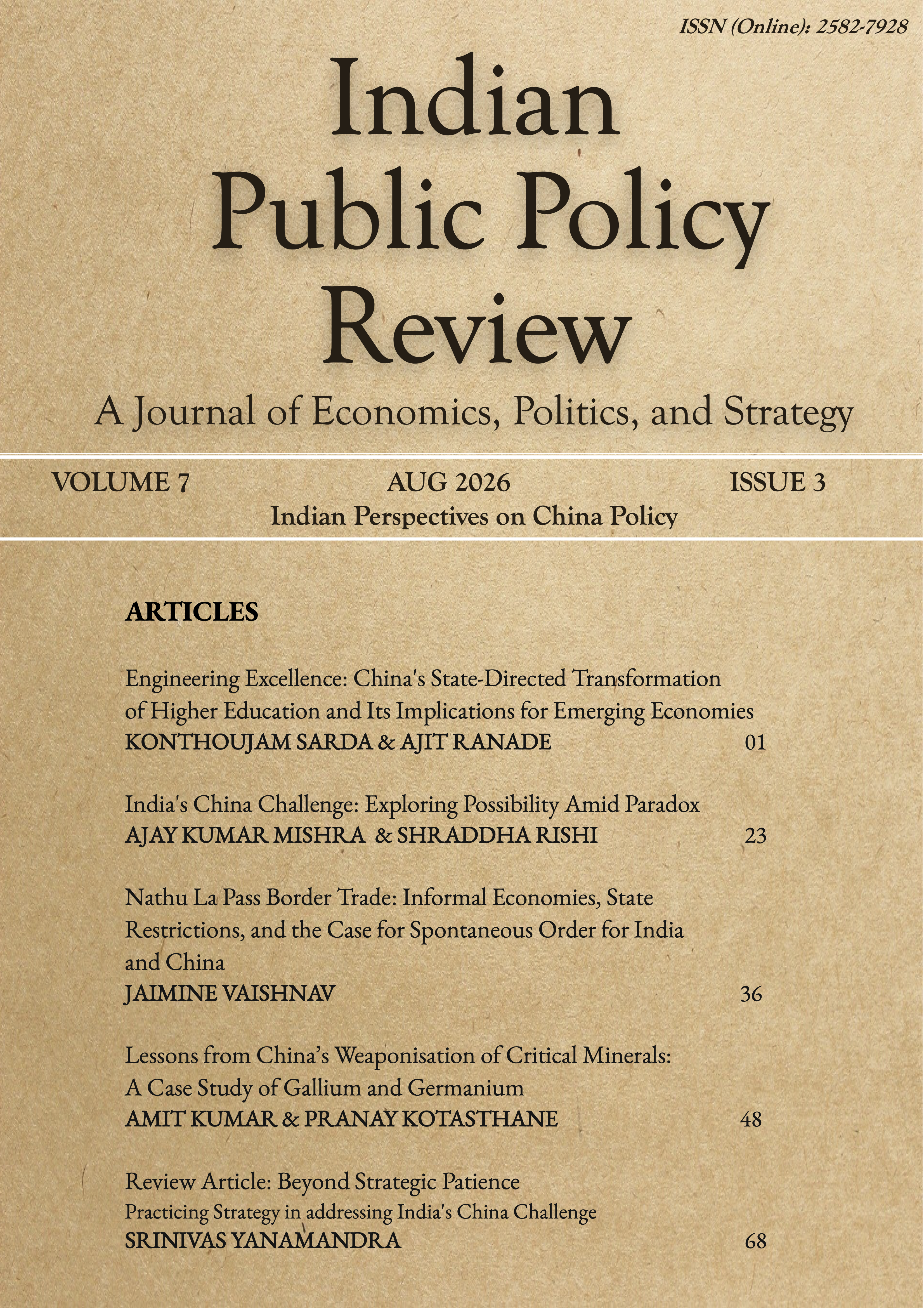
This special issue on Indian perspectives on China policy opens with Sarda and Ranade's analysis of China's state-directed transformation of higher education, which theorises a concentration paradox - elite targeting with fiscal restraint outperforming broad expenditure expansion. Mishra and Rishi examine India's economic and strategic entanglement with China, arguing that a multi-alignment strategy combining defensive diplomacy with supply-chain diversification best preserves strategic autonomy. Vaishnav traces the political economy of Nathu La Pass border trade, finding that regulatory restrictions rather than weak demand have suppressed formal trade and fuelled informal exchange, and calls for calibrated reform. Kumar assesses China's 2023-2025 export controls on gallium and germanium, concluding that despite sharp price volatility, Beijing failed to secure lasting leverage as the United States diversified suppliers and built domestic capability. Finally, Yanamandra's review article analyses Bambawale et al.'s Rising to the China Challenge alongside Kewalramani's Taming the Dragon, tracing how India's China strategy has moved from a framework of strategic patience to detailed operational tools across military, trade, diplomatic, and institutional domains.                          
Published: 2026-08-03

  • Engineering Excellence: China's State-Directed Transformation of Higher Education and Its Implications for Emerging Economies

    Konthoujam Sarda, Ajit Ranade
    1-22

    China’s emergence as a global leader in higher education and scientific research over the past three decades represents one of the most consequential transformations in the modern history of knowledge production. This paper argues that China’s ascent is neither organic nor accidental, but rather the product of deliberate, state-engineered policy pursued with unusual consistency across successive administrations. Drawing on data from different databases, we document the scale, pace, and strategic logic of this transformation. The paper makes three original contributions. First, it names and theorises the concentration paradox: the counter-intuitive finding that elite targeting with fiscal restraint can outperform the universal-expansion model recommended by mainstream policy orthodoxy. Second, it uses ASPI 2025 data to offer a specific diagnosis of India’s technology-research gap as a problem of ‘breadth without depth’ — India appears in the global top five for approximately 50 of 74 critical technologies but leads in none — and argues this is a structurally different failure mode from simply spending too little. Third, it derives from the China analysis a concrete five-point policy agenda for India, adapted for democratic governance. We also identify significant limitations of China’s model: research-integrity concerns, academic freedom constraints, and deep geographic inequality within the Chinese university system.

  • India's China Challenge: Exploring Possibility Amid Paradox

    Ajay Kumar Mishra, Shraddha Rishi
    23-35

    India's dilemma with China is characterised by increased bilateral trade, border disputes, and geostrategic rivalries. The coexistence of territorial conflict and trade highlights India's vulnerability to China. This study calls for a reassessment of economic efficiency to address the diplomatic costs of production and the importance of adaptable international diplomacy. The ability to navigate diplomatically in a hostile and interconnected geoeconomy and geopolitics is a key indicator of economic efficiency. Furthermore, it asserts that, under a multi-alignment framework, a defensive diplomacy approach is more effective in achieving and maintaining strategic autonomy. Therefore, diversifying supply chains and establishing geoeconomic partnerships with other nations are India's top priorities to manage its relationship with China. India has strategic opportunities consequent upon China's growing global influence and its disputes with the US-led Western world order. Additionally, India's multi-alignment strategy reduces geopolitical tension among external powers by reducing dependence on any single country.

  • Nathu La Pass Border Trade Informal Economies, State Restrictions, and the Case for Spontaneous Order for India and China

    Jaimine Vaishnav
    36-47

    The reopening of Nathu La Pass in 2006 marked a symbolic milestone in India-China relations, yet nearly two decades later, formal border trade through this historic route remains negligible relative to its projected potential. This paper examines the political economy of Nathu La border trade, using libertarian political economy as a primary analytical lens while situating that lens within the broader context of India-China security dynamics, diplomatic constraints, and state capacity. The central argument is that excessive regulatory restrictions, including outdated commodity lists, seasonal closures, and bureaucratic licensing requirements, have depressed formal trade volumes and encouraged informal exchange in their place. Drawing on the 2020-2024 closure and the 2025 resumption of trade, the paper documents how state-imposed barriers have constrained voluntary exchange and generated informal trading networks that reflect genuine demand patterns. The acknowledges the limits of available data on informal trade and interprets indirect evidence with care. The findings suggest that meaningful trade expansion requires regulatory reform, but reforms must be calibrated to security realities rather than treated as purely technical exercises.

  • Lessons from China’s Weaponisation of Critical Minerals A Case Study of Gallium and Germanium

    Amit Kumar, Pranay Kotasthane
    48-67

    China’s weaponisation of its dominance in the production of gallium and germanium between 2023 and 2025 failed to achieve sustained leverage over the United States. While Beijing’s restrictive licensing requirements, and subsequent blanket ban successfully induced significant price volatility — with international retail benchmarks for high-purity variants appreciating by over 200 per cent — export controls did not translate into a contraction of the US’ industrial consumption. The assessment reveals that the US’ demonstrated remarkable resilience, bolstered by rapid substitutability, supply chain diversification, and even domestic capability building. For gallium, the US successfully pivoted to Japanese, German, and Canadian suppliers, reducing reliance on direct Chinese imports. With respect to Germanium, the US succeeded in insulating itself by relying on diversification, limited domestic production and robust domestic recycling capability.

  • Beyond Strategic Patience Practicing Strategy in addressing India's China Challenge

    Srinivas Yanamandra
    68-71

    In the expanding body of Indian policy literature on managing the China challenge since the 2020 border crisis, this article focuses on two works: Bambawale et al.’s Rising to the China Challenge: Winning through Strategic Patience and Economic Growth (2021), and Kewalramani (ed.)’s Taming the Dragon: A Manifesto for a New Modus Vivendi with China (2026). Published roughly five years apart, the two help assess how thinking in India has evolved over this period. While the earlier work defines the direction of “Strategic Patience” at a conceptual level, the later work translates that direction into ground-level prescriptions for its practical implementation.