
Vol. 7 No. 1 (2026): Indian Public Policy Review

					View Vol. 7 No. 1 (2026): Indian Public Policy Review
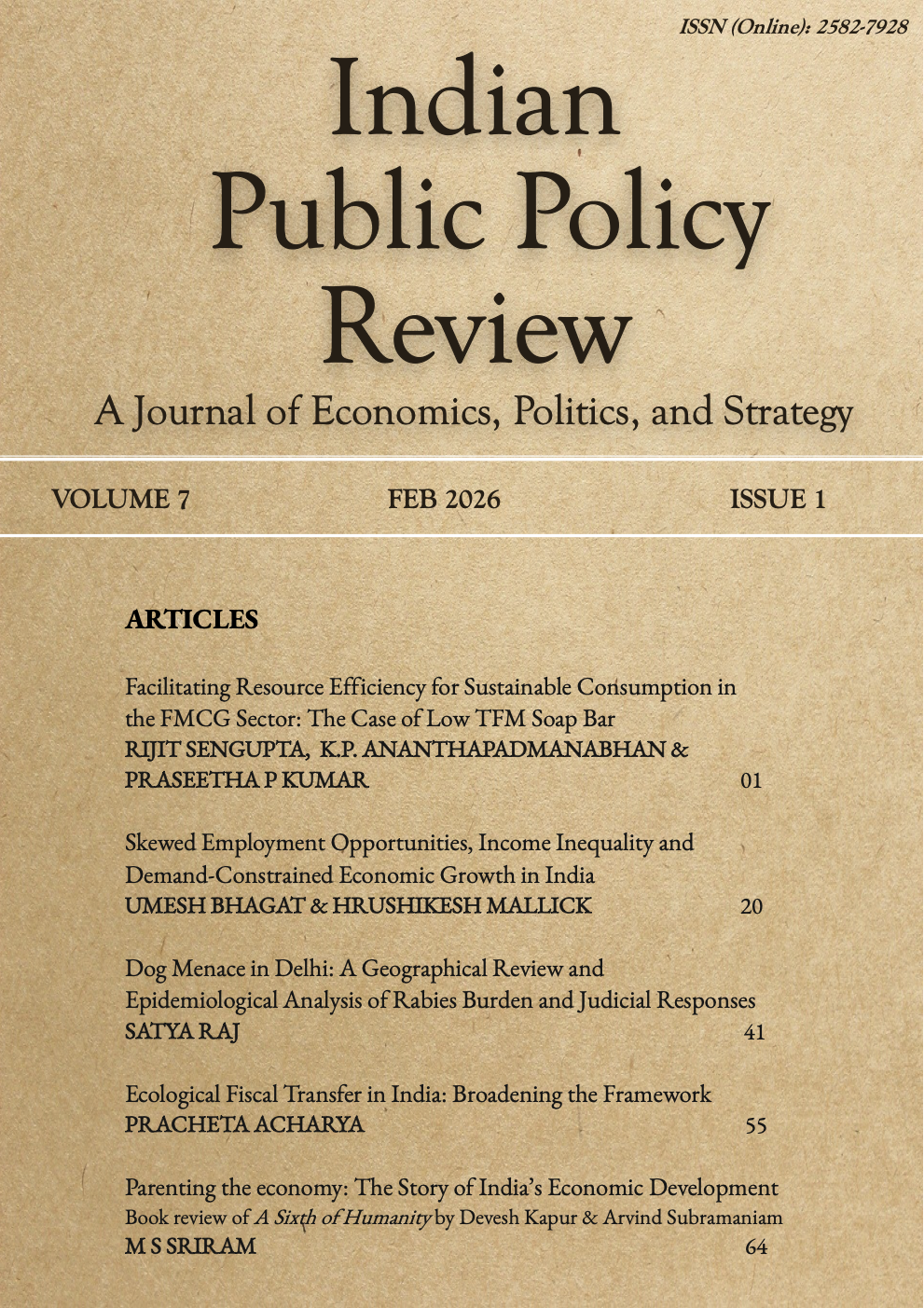
This issue opens with Sengupta, Ananthapadmanabhan, and Kumar’s conceptual policy paper, which uses the case of low Total Fatty Matter soap bars to argue that science-based regulatory reform in the FMCG sector can enhance resource efficiency, reduce palm-oil–linked deforestation, and align consumer protection standards with sustainability objectives. Bhagat and Mallick examine how skewed employment opportunities and income inequality constrain India’s aggregate demand and long-run growth. Raj’s article on the dog menace in Delhi combines geographical and epidemiological analysis to map dog-bite and rabies risks, and proposing spatially targeted, humane interventions within the existing legal framework. Acharya’s commentary on ecological fiscal transfers argues that India’s current forest-based criterion, while a step forward, remains too narrow and should evolve into a multidimensional environmental component to better reflect subnational conservation responsibilities and expenditure pressures. Finally, Sriram’s review of Kapur and Subramanian’s "A Sixth of Humanity" reflects on India’s post-independence development trajectory. 

 

Published: 2026-03-01
  • Facilitating Resource Efficiency through Regulatory Reform for Sustainable Consumption in the FMCG Sector The Case of Low TFM Soap Bar

    Rijit Sengupta, Ananth, Praseetha P Kumar
    1-19

    This conceptual policy paper with a specific technology case study underlines the importance of using scientific evidence in strengthening regulation to promote resource efficiency for sustainable consumption in the Fast-Moving Consumer Goods (FMCG) sector in India. It explores how science-based innovations, facilitated through regulatory reform and informed consumer engagement, can help improve material use efficiency, thereby decoupling economic growth from resource depletion and negative environmental impacts. The discussion situates this need within the current market dynamics, highlighting rising consumer awareness, persistent intent–action gaps in sustainable consumption, and evolving business responses ranging from technology-driven innovation to choice influencing and choice editing. Using the example of one of the simplest and widely used FMCG products - the soap bar, it illustrates how reducing Total Fatty Matter in soap bar (TFM is derived from palm oil) through alternative structurants can optimise palm oil use without compromising its performance. The paper thereby underlines that efficient use of TFM in soap bars can contribute towards addressing the associated risk of deforestation, and makes a case for the national standard to be accordingly refined. Building on these insights, the paper outlines an integrated analytical approach that combines business reform strategies supported by science-based research and innovation, leadership thinking, and policy engagement, with enabling regulatory frameworks and consumer education.

  • Skewed Employment Opportunities, Income Inequality and Demand-Constrained Economic Growth in India

    Umesh Bhagat, Hrushikesh Mallick
    20-40

    This study examines India’s long-run economic growth potential and the constraints on its path to faster economic and social progress, and suggests policy pathways to expand domestic market size and facilitate inclusive growth. Using various secondary data sources, we argue that India needs to broaden its internal domestic market, which can remove significant demand constraints at a crucial juncture when the world economy is witnessing a major economic and political upheaval. Although the demand-constrained economic growth can be overcome through significant policy interventions, the key is to broaden the job ladder at the top rungs (formal jobs) and narrow down the job opportunities at the bottom rungs (informal jobs) to reduce income inequality. Additionally, this can be achieved by generating inclusive and fair employment opportunities for the most disadvantaged households. This would result in an increase in their income levels and the economy's overall demand, which would in turn generate virtuous cycles of rapid economic growth and further expand the market size within the economy. Therefore, the study concludes that the bottom strata of households need to have equality of opportunities in terms of access to quality education, health facilities, employment, and income, which would enhance social and economic upward mobility. Otherwise, it can exacerbate macroeconomic instability if inequality worsens further.

  • Dog Menace in Delhi A Geographical Review and Epidemiological Analysis of Rabies Burden and Judicial Responses

    Satya Raj
    41-54

    Free-roaming dogs are a persistent issue in many Indian cities.  In Delhi, rising dog-bite incidences and reported rabies cases have prompted intense public debate, policy action by municipal agencies, and a high-profile Supreme Court intervention in August 2025. This review examines the geography of the stray dog–human conflict in Delhi, focusing on dog-bite trends, rabies epidemiology, and governance responses, including the 2025 Supreme Court judgment on dog management. Using published epidemiological studies, municipal surveillance data, and Animal Birth Control (ABC) programme documents, the paper analyses temporal and seasonal dog-bite patterns and identifies neighbourhood-level risk concentrations driven by waste availability, urban density, and uneven ABC coverage. Comparative cases from Bengaluru, Kerala, and Mumbai show similar challenges of fragmented implementation, rapid dog population turnover, and persistent hotspots, while Kerala’s expanded anti-rabies initiatives demonstrate measurable reductions in human rabies but heightened community tensions. Findings highlight the need for spatially targeted interventions, improved waste management, and strengthened ward-level sterilisation and vaccination cycles. The study concludes that Delhi’s conflict is shaped by ecological and institutional factors, and that durable solutions require aligning public-health priorities with legal and animal-welfare frameworks.

  • Ecological Fiscal Transfer in India Broadening the Framework

    Pracheta Acharya
    55-63

    India adopted ecological fiscal transfer (EFT) in the 14th Finance Commission (FC) and redefined the tax share formula by adding the net forest cover alongside other parameters such as population, income, area, tax collection, and demographic performance. The 16th FC has tried to bring some positive changes in the EFT formula by combining the share of weighted forest area and share of increase in the weighted forest area of states to address oversimplification of the ecological variable. However, the EFT has more potential, beyond just forest. Other national-level issues, specifically air and water pollution, trickle down to the local level, squeezing the subnational expenditure. Therefore, including pollution in fiscal transfers would do justice to lower-level governance. In this context, the ‘Forest and Ecology’ in the tax devolution can be replaced with a multidimensional environmental component, combining the forest, air and water quality. However, if the union government is not confident enough to experiment with the pollution angle in the transfer mechanism, they can consider including biodiversity in the transfer formula as an immediate action. This will be a less radical way to modify the EFT framework by integrating biodiversity along with forest cover, keeping the essence of forest and ecology in the centre of EFT. The commentary offers an alternative narrative for the EFT mechanism in India and paves a way to a different set of ideas that can be further expanded and studied empirically.

  • Parenting the economy: The Story of India’s Economic Development Review article based on “A Sixth of Humanity: Independent India’s Development Odyssey” by Devesh Kapur & Arvind Subramaniam

    M S Sriram
    64-69

    This article reviews Devesh Kapur and Arvind Subramanian’s study of India’s post‑independence development, which portrays a “precocious” democracy combining enlightened ambitions with a weak institutional and social base. It highlights their diagnosis of prolonged ruralisation, stunted industrialisation and early servicification, and assesses their claim that paternalistic centralisation, inefficient nationalisation and incomplete structural transformation produced islands of excellence amid broad underperformance.