
Vol. 7 No. 4 (2026): Indian Public Policy Review
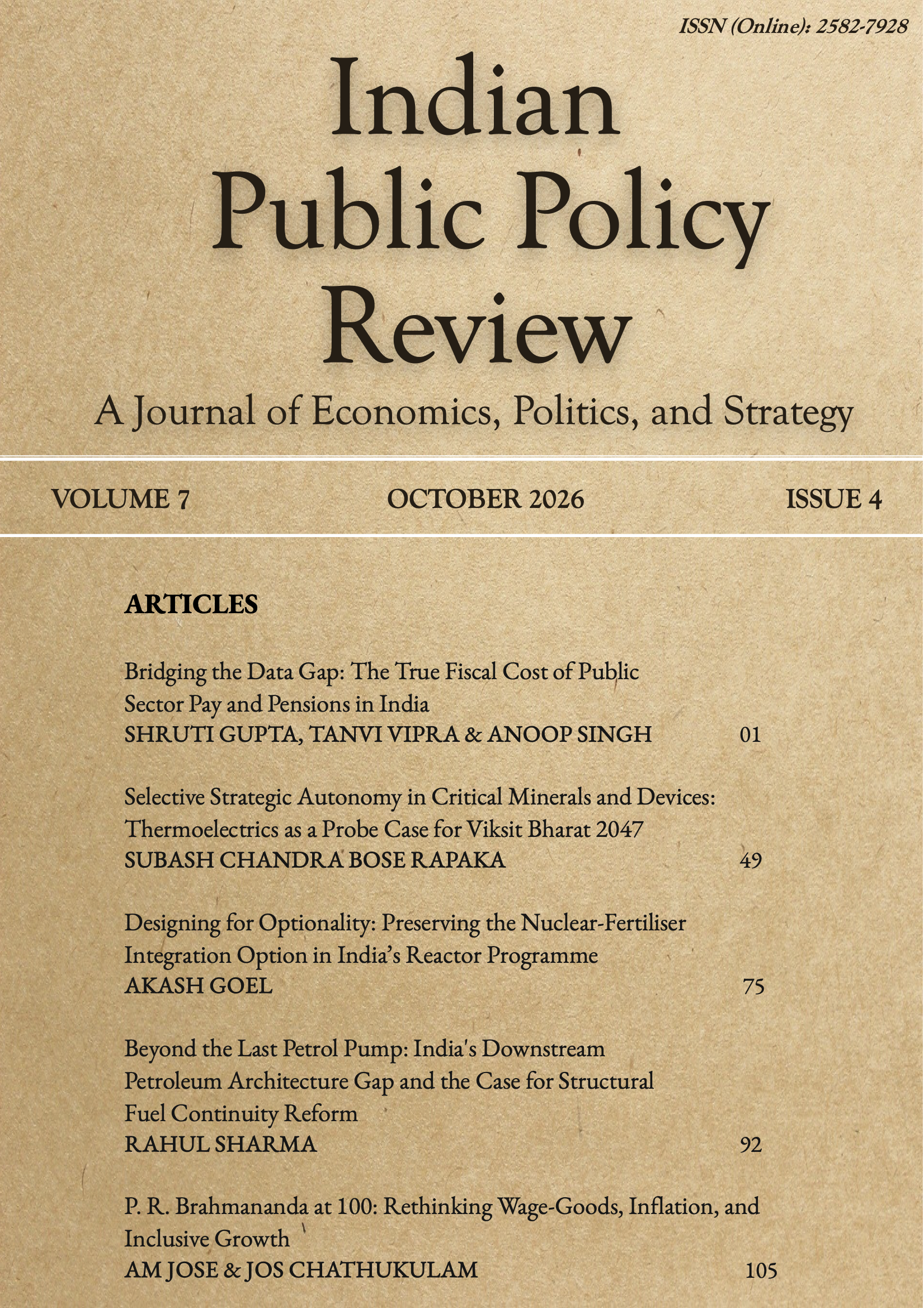
The lead paper by Gupta, Vipra, and Singh shows that India’s official statistics systematically understate compensation bills and proposes comprehensive coverage and standardised reporting to estimate the fiscal cost of public sector employment more accurately. Rapaka assesses vulnerabilities in thermoelectric-relevant mineral chains and, using thermoelectrics as a probe case, develops three scenarios for 2047 and a three-pillar framework for selective strategic autonomy. Goel argues that India should preserve the option of coupling nuclear reactors to fertiliser production through six provisions in reactor design, siting, clearance, safety, licensing, and ownership. Sharma identifies five structural deficiencies in India’s downstream petroleum architecture and proposes five policy steps to improve fuel continuity. Finally, Jose and Chathukulam’s commentary marks P. R. Brahmananda’s birth centenary by tracing his wage-goods critique of planning and writings on inflation as one coherent framework linking employment, productive capacity, price stability, and welfare.